
Selection of crusher for bauxite processing plant
Selecting the right crusher for a bauxite processing plant is essential for achieving reliable throughput, consistent product sizing, and efficient downstream alumina production. Unlike many conventional hard-rock ores, bauxite exhibits distinctive physical and mineralogical characteristics that significantly influence crushing performance. Its moderate compressive strength, variable hardness, high surface moisture, and clay-rich composition can create operational challenges, particularly in conventional high-compression crushing systems.
Therefore, crusher selection should be based not only on production capacity and feed size but also on a detailed understanding of ore properties. A material-science-driven approach helps identify the most appropriate equipment configuration for primary and secondary crushing while minimizing blockages, excessive fines generation, and maintenance requirements.
1. Understanding the Physical and Mineralogical Characteristics of Bauxite
Bauxite is a heterogeneous sedimentary or residual ore primarily composed of aluminum-bearing minerals, including gibbsite, boehmite, and diaspore. It commonly contains impurities such as hematite, goethite, kaolinite, and other aluminosilicate clays.
Several characteristics directly influence crusher selection:
Moderate compressive strength: Bauxite typically exhibits compressive strength in the approximate range of 60–150 MPa, although actual values vary with mineral composition, cementation, porosity, and weathering. This strength range generally allows efficient size reduction using jaw and impact crushers without necessarily requiring the high compression forces associated with some hard-rock applications.
Variable Mohs hardness: The hardness of bauxite depends on its dominant aluminum-bearing minerals and associated impurities. Gibbsite-rich ores are generally softer, while boehmite- and diaspore-rich materials can exhibit greater resistance to crushing. This variability requires equipment capable of handling changing feed characteristics.
High surface moisture: Run-of-mine bauxite frequently contains significant moisture, particularly when extracted during wet seasons or from tropical deposits. Moisture encourages fine particles to adhere to equipment surfaces, increasing the risk of material buildup and restricted discharge.
Sticky clay and iron-oxide matrices: Kaolinite, other aluminosilicate clays, and iron oxides can form cohesive matrices around bauxite particles. Under compression, these materials may compact rather than fracture cleanly, creating sticky agglomerates and contributing to chamber packing and screen blinding.
These characteristics make conventional high-compression cone crushers potentially problematic in certain bauxite applications. Their confined crushing chambers and continuous compression cycles can encourage wet fines to accumulate between crushing surfaces. The resulting material buildup reduces effective chamber volume, restricts material movement, increases power consumption, and causes unstable production.
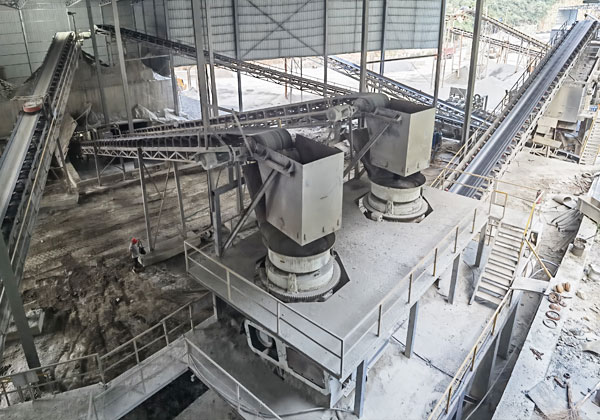
2. Primary Crushing: Vibrating Grizzly Feeder and Jaw Crusher
The primary crushing circuit should prioritize feed preparation, reliable material handling, and resistance to blockage.
vibrating grizzly feeder
A vibrating grizzly feeder is an effective first-stage component for bauxite processing. Its primary function is to regulate the flow of run-of-mine material while separating naturally occurring fines before they enter the primary crusher.
This pre-scalping operation offers several advantages:
- Removes wet, sticky fines that would otherwise accumulate inside the crusher.
- Reduces unnecessary crushing energy consumption.
- Improves primary crusher feed consistency.
- Minimizes material buildup and operational interruptions.
Grizzly openings should be selected according to the required product specification and the particle-size distribution of the raw ore. The feeder should also incorporate suitable wear-resistant components and an appropriate discharge arrangement to accommodate abrasive iron-rich material and variable moisture conditions.
C6X Series jaw crusher
Following pre-scalping, a primary jaw crusher such as the C6X Series provides a practical solution for reducing oversized bauxite lumps.
Jaw crushers operate through compression between a stationary jaw plate and a moving jaw plate. Their relatively open crushing geometry provides a more suitable material passage for many wet, moderately strong bauxite ores than a tightly confined cone-crushing chamber.
Important selection considerations include:
- A suitable steep nip angle to capture incoming lumps effectively.
- Adequate feed opening for the maximum run-of-mine particle size.
- Non-choking discharge geometry that facilitates material movement.
- Sufficient motor power and structural strength for variable ore hardness.
- Wear-resistant jaw plates appropriate for the abrasive mineral fraction.
The primary crushing stage should produce a controlled, relatively coarse product while avoiding excessive fines generation. Correct feeder coordination and discharge clearance are particularly important when processing moist, clay-rich bauxite.
3. Secondary Crushing: Impact Crushers and Mineral Sizers
The secondary crushing stage should achieve the required product size without generating excessive fines or slimes.
CI5X Series impact crusher
A secondary impact crusher, such as the CI5X Series, can be considered for suitable bauxite applications. Unlike conventional compression-based systems, impact crushers use high-speed rotor movement and impact forces to break particles.
Their advantages include:
- Effective reduction of moderately strong bauxite.
- Flexible product-size adjustment.
- Relatively simple crushing mechanisms.
- Potentially favorable particle-size distribution for downstream processing.
However, rotor speed, feed rate, impact plate configuration, and discharge settings must be carefully optimized. Excessive impact energy can generate unwanted fines, particularly when processing soft, gibbsite-rich bauxite.
Moisture content must also be evaluated because sticky clay can accumulate around internal surfaces and discharge openings. Adequate pre-screening, chamber inspection, and material-flow management are therefore essential.
Mineral sizers
For highly cohesive, moisture-rich, and clay-bearing bauxite, mineral sizers may provide an alternative secondary crushing solution. These machines employ low-speed, high-torque rotating shafts equipped with crushing teeth.
Their relatively controlled crushing action can reduce excessive particle degradation while maintaining a consistent product size. Mineral sizers are particularly attractive where preserving coarse particle fractions and limiting slimes generation are important operational objectives.
Selection should consider tooth configuration, shaft spacing, torque requirements, wear resistance, and the ore’s tendency to form sticky agglomerates.
4. Developing an Integrated Crushing Circuit
An effective bauxite crushing circuit should combine equipment according to material characteristics rather than relying on individual crusher specifications.
A practical configuration is:
Run-of-mine bauxite → Vibrating grizzly feeder → C6X Series jaw crusher → CI5X Series impact crusher or mineral sizer → Product screening → Stockpile or downstream processing.
The final equipment arrangement should be established through representative ore testing, including moisture analysis, particle-size distribution, compressive strength testing, mineralogical characterization, and laboratory crushing trials.
The required product size must also reflect the downstream process. For Bayer-process alumina refining, controlled particle sizing supports effective digestion and predictable slurry preparation. For bauxite calcination, consistent feed sizing helps improve thermal treatment uniformity and product quality.
Conclusion
The selection of crushers for a bauxite processing plant requires a material-science-driven approach that accounts for ore strength, mineral hardness, moisture, clay content, and particle degradation characteristics. Vibrating grizzly feeders, C6X Series jaw crushers, and CI5X Series impact crushers or mineral sizers offer a flexible equipment combination for addressing these challenges.
By prioritizing effective pre-scalping, non-choking material flow, controlled size reduction, and minimized fines generation, plant operators can develop a more reliable and energy-efficient crushing circuit. Ultimately, matching crushing technology to the mineralogical and physical properties of bauxite improves operational stability and provides consistent feed quality for downstream alumina refining and calcination.