
Equipment for the Crushing Stage in Mining
The crushing stage is a critical component of mineral processing, reducing run-of-mine (ROM) ore to a controlled particle size suitable for downstream grinding, classification, and mineral recovery. As a lead comminution process engineer, I recommend selecting crushing equipment based on ore competency, feed size, abrasiveness, throughput requirements, target product size, and total operating cost. A properly engineered crushing circuit balances reduction ratio, equipment availability, energy consumption, and product-size consistency while minimizing unnecessary fines and downstream bottlenecks.
Primary Crushing Stage: Managing ROM Ore
Primary crushing receives ROM material directly from the mine and performs the initial size reduction. Equipment must withstand high impact loads, variable feed conditions, and large, irregular rock fragments.
Primary jaw crushers use a compressive crushing mechanism between fixed and moving jaw plates. They are well suited to hard, abrasive ores and operations requiring robust mechanical simplicity. Their relatively straightforward maintenance requirements make them attractive for smaller and medium-capacity installations, although capacity and feed-opening dimensions must accommodate the maximum expected ROM size.
Primary gyratory crushers are commonly selected for large-scale mines requiring high, continuous throughput. Their gyrating crushing head provides compression against a stationary concave surface, enabling efficient processing of large feed sizes. These crushers are particularly appropriate for high-capacity operations where truck-dump arrangements and continuous plant availability are major design considerations. Foundation requirements, installation height, and capital cost must be evaluated early.
Primary impact crushers use high-speed impact to fracture material and can achieve substantial reduction in a single stage. They are generally more suitable for softer, less abrasive materials, including certain limestone deposits. Highly abrasive, competent ores can accelerate wear and increase maintenance costs, making impact crushing less attractive for many hard-rock applications.
Primary-stage design should also consider surge capacity, feed distribution, tramp-metal removal, and protection against oversized rocks.
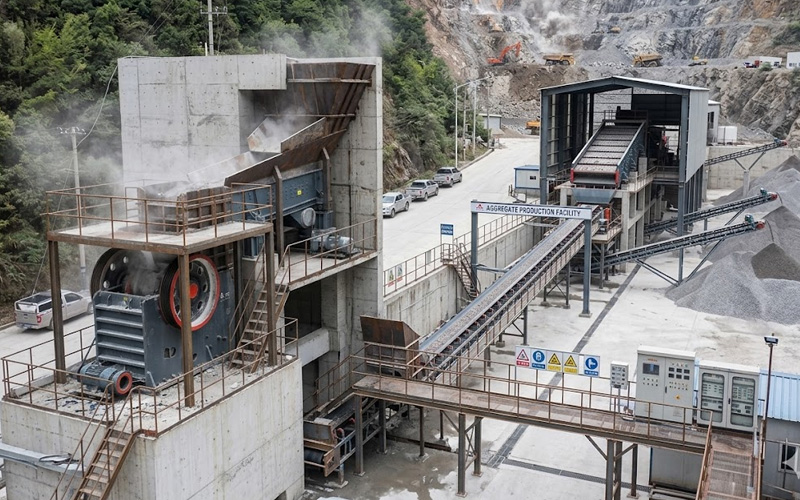
Secondary Crushing Stage: Controlling Feed for Further Reduction
Secondary crushing reduces primary crusher discharge to a size suitable for tertiary crushing or, in some circuits, direct grinding. The main equipment choices are cone crushers and heavy-duty impact crushers.
Standard cone crushers apply compression between a rotating mantle and a stationary concave. They are widely used for hard-rock applications because they offer reliable reduction, high capacity, and good wear performance when correctly selected. Chamber geometry, eccentric throw, closed-side setting (CSS), and feed gradation determine capacity and product-size distribution. Consistent choke feeding is often essential for stable operation and effective liner utilization.
Standard impact crushers use impact energy to break material against breaker plates or anvils. They can produce a well-shaped product and achieve relatively high reduction ratios, particularly with moderately abrasive feed. However, wear rates and maintenance requirements can rise sharply when processing hard, abrasive ores.
At this stage, engineers should assess whether the secondary crusher can meet the tertiary feed specification without creating excessive fines or overloading downstream screens. Feed segregation, moisture, and clay content can materially affect circuit performance.
Tertiary and Quaternary Crushing: Optimizing Fine Generation
Tertiary and quaternary stages produce finer material, often with the objective of improving grinding-circuit performance or preparing feed for downstream processing.
Vertical shaft impact (VSI) crushers accelerate feed against a rock bed or impact surfaces. They are especially useful when particle shape, additional fines generation, or manufactured sand production is important. Their suitability depends on ore abrasiveness, the required product specification, and wear-part economics.
The preferred configuration should be established through ore testing and comparative energy, wear, and throughput assessments rather than equipment specifications alone.
Auxiliary Equipment Integration
Crushing equipment cannot operate efficiently without a coordinated material-handling system.
- Scalping grizzlies remove undersized material before primary crushing, reducing unnecessary crusher loading and improving effective capacity.
- Vibrating screens classify crushed ore, returning oversize material for further reduction when configured in closed circuit.
- Heavy-duty apron feeders provide controlled discharge from ROM bins and surge hoppers, handling large, heavy, and irregular rocks.
- Belt conveyors transfer material between stages and stockpiles, with capacity, transfer-point geometry, dust control, and spillage management incorporated into the design.
Chutes, magnets, metal detectors, dust suppression, and tramp-material protection should also be integrated where required. Feeders and conveyors must be sized for peak operating conditions, not merely average throughput.
Open-Circuit vs. Closed-Circuit Crushing
In an open-circuit configuration, material passes through a crusher without downstream screening and oversize recirculation. This arrangement simplifies the flowsheet and may reduce capital cost, but product-size distribution is less tightly controlled. It is appropriate when downstream equipment can accommodate variable feed sizes.
In a closed-circuit configuration, screens separate acceptable product from oversize material, which returns to the crusher. This improves top-size control and can increase the proportion of material meeting the required specification. However, recirculating loads increase equipment duty, conveyor requirements, and control-system complexity.
Circuit efficiency depends on screen performance, circulating load, crusher capacity, and feed variability. Closed circuits generally offer tighter product control, while open circuits can be advantageous where simplicity and low capital cost dominate.