
Crushing of manufactured sand for aggregates
Manufactured sand has become an essential alternative to natural sand in modern concrete and aggregate production. Produced by crushing and shaping quarried rock, it offers a controllable source of fine aggregate while reducing dependence on increasingly scarce natural resources. However, high-quality manufactured sand requires more than simply reducing rock size. The crushing process must control particle shape, fineness modulus, stone powder content, and internal aggregate integrity. Vertical-shaft impact (VSI) crushers are particularly effective because they use high-speed stone-on-stone collisions to produce well-shaped particles and improve grading consistency.
Mechanics of Stone-on-Stone Collision Dynamics
The working principle of a VSI crusher relies on accelerating rock particles to high velocities before directing them toward a stone-lined crushing chamber or an opposing particle stream. Upon impact, the particles collide with one another or with the surrounding rock bed, generating localized compressive and shear stresses that initiate fracture.
Unlike conventional compression crushers, which primarily apply pressure between rigid surfaces, VSI crushers use impact energy to break particles along natural weaknesses. This mechanism can promote selective fragmentation, reduce elongated and flaky particles, and generate more cubical aggregates.
Collision efficiency depends on rotor speed, feed rate, particle size distribution, rock hardness, and the configuration of the crushing chamber. Excessive rotor speed increases impact energy and may improve shaping, but it can also produce excessive fines and increase energy consumption. Insufficient speed may leave particles poorly shaped or inadequately reduced.
The objective is to establish a stable collision regime in which particles receive enough energy for effective fracture and shaping without unnecessary over-crushing. Consistent feed distribution and suitable rotor settings are therefore essential to maintaining production efficiency and aggregate quality.
Controlling Particle Shape and Fineness Modulus
Particle shape directly affects concrete workability, packing density, and cement paste demand. Angular, cubical manufactured sand generally provides better interlocking than elongated or flaky particles, although excessive angularity and roughness can increase water demand.
VSI crushing improves particle shape by repeatedly exposing irregular fragments to controlled impacts. However, the final shape also depends on the parent rock, feed gradation, rotor configuration, and the number of crushing passes. Operators should monitor particle shape alongside particle-size distribution rather than treating maximum crushing intensity as the primary objective.
Fineness modulus (FM) is an index describing the relative coarseness or fineness of sand, calculated from the cumulative percentages retained on a specified series of standard sieves, divided by 100. A higher FM indicates coarser sand, while a lower value indicates finer material.
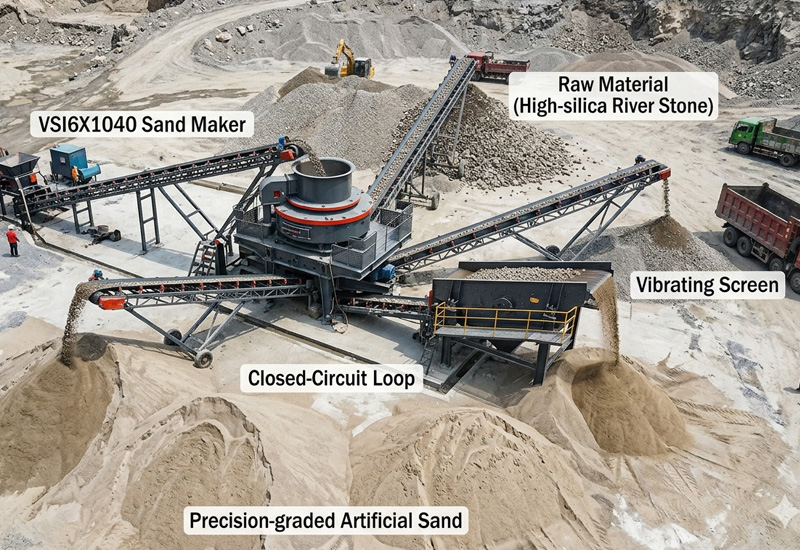
FM control requires coordination between crusher operation and downstream screening. Excessive fine-particle generation lowers FM, whereas insufficient reduction can produce sand that is too coarse. Closed-circuit crushing, adjustable rotor speed, and recirculation of oversize material help maintain a stable grading curve. Because FM alone cannot describe the complete particle-size distribution, sieve analysis should also verify the percentage passing each relevant sieve.
Optimizing Stone Powder Content
Stone powder, typically the fraction finer than 75 micrometres, is an important component of manufactured sand. In suitable quantities, it can fill voids between larger particles, improve packing density, and enhance the cohesion of fresh concrete. Excessive powder, however, may increase water demand, impair workability, or introduce unwanted clay-related effects.
Optimal stone powder content depends on the parent rock, mineral composition, concrete application, and applicable aggregate standards. Consequently, there is no universal target suitable for every production line.
Effective control begins with classifying and measuring the fines produced during crushing. Air classification, washing, and controlled blending can adjust powder content to meet project requirements. Washing may be appropriate when powder levels are excessive or contaminants are present, while dry classification can retain useful mineral fines and reduce water consumption.
Regular sampling should assess both powder quantity and quality. Clay-bearing fines must be distinguished from clean rock powder because their effects on concrete performance can differ substantially.
Minimizing Micro-Cracks and Preserving Aggregate Integrity
Micro-cracks can form when impact stresses exceed the local fracture resistance of rock particles. Existing mineral weaknesses, weathered zones, and excessive repeated impacts can increase susceptibility to internal damage. Such cracks may reduce particle strength, increase water absorption, and impair long-term durability.
Although VSI crushers can produce controlled fractures and favorable particle shapes, they cannot guarantee the complete elimination of micro-cracks. Effective production therefore focuses on minimizing unnecessary damage while achieving the required particle size.
Practical measures include selecting sound, uniform feed material; optimizing rotor speed and feed rate; preventing unstable loading; and avoiding excessive recirculation. A well-designed crushing circuit distributes size reduction across suitable stages rather than relying on repeated high-energy impacts.
Quality assurance should combine aggregate crushing or abrasion tests, water absorption measurements, petrographic examination, and, where justified, microscopic inspection. These methods help distinguish acceptable fracture surfaces from damaging internal cracking and reveal whether operating adjustments improve aggregate integrity.
Conclusion
High-quality manufactured sand production depends on balancing impact mechanics, particle shaping, grading control, powder optimization, and aggregate durability. VSI crushers provide a versatile means of achieving this balance through stone-on-stone collision dynamics. By controlling operating conditions, integrating screening and classification, and monitoring material properties, producers can manufacture sand with consistent fineness modulus, suitable stone powder content, favorable particle shape, and minimized micro-crack damage. The result is a more reliable fine aggregate that supports efficient concrete production and durable construction.