
Crushing equipment for 10–16 mm crushed stone
Producing high-quality 10–16 mm crushed stone for premium concrete requires more than simply reducing rock to the target size. The crushing circuit must control particle size, shape, fines generation, and recirculation simultaneously. In particular, achieving a flakiness and elongation ratio below 8% requires a precisely coordinated combination of secondary crushing, shaping, and multi-deck screening.
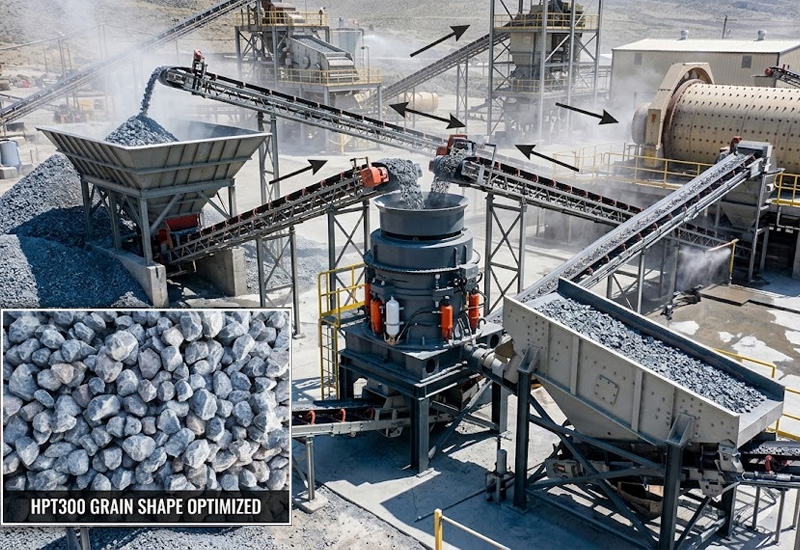
A practical solution is a multi-stage circuit incorporating an HST or HPT Hydraulic Cone Crusher, a VSI6X or VSI Sand Making Machine, and an S5X Vibrating Screen. When correctly synchronized, these machines can maximize the proportion of saleable 10–16 mm aggregate while minimizing oversized particles and poorly shaped stones.
1. Start with a Controlled Primary and Secondary Crushing Stage
A typical circuit begins with primary crushing to reduce blasted rock into a manageable size range, followed by secondary crushing for more precise reduction. For hard and abrasive rock, a hydraulic cone crusher such as an HST or HPT can provide the controlled crushing action required for aggregate production.
The key parameter is the closed-side setting (CSS). A smaller CSS generally increases the proportion of fine and correctly sized material, but excessive reduction can generate unnecessary fines and increase circulating load. Conversely, a CSS that is too large may leave excessive oversize, reducing the efficiency of downstream screening.
For a 10–16 mm target product, the secondary cone crusher should therefore be configured based on the actual feed gradation, rock characteristics, and desired product curve rather than relying on a fixed CSS value. Trial operation and laboratory gradation testing are essential for establishing the optimum setting.
2. Add Shaping Where Particle Geometry Is Critical
Crushing alone does not always produce the particle shape required for premium concrete aggregate. Even when the material meets the 10–16 mm size range, elongated or flaky particles can negatively affect packing, workability, and concrete performance.
A VSI6X Vertical Shaft Impact Crusher or VSI Sand Making Machine can be introduced as a shaping stage. Instead of relying primarily on compression, VSI technology uses high-speed impact to improve particle cubicity and reduce undesirable elongated forms.
The shaping stage should be synchronized with the cone crusher rather than operated independently. If the cone crusher produces an excessive quantity of near-specification material, sending all of it through the VSI may increase power consumption and unwanted fines. A more efficient approach is to direct selected fractions requiring additional shaping to the VSI while allowing already well-shaped particles to proceed toward classification.
3. Use Multi-Deck Screening for Precise Classification
The S5X Vibrating Screen provides the classification stage needed to separate the 10–16 mm product from undersize and oversize material. Multi-deck screening enables several fractions to be separated simultaneously, creating greater control over the final aggregate gradation.
Screen aperture selection is particularly important. The deck responsible for recovering the 10–16 mm fraction must provide sufficient screening efficiency without excessive blinding or overloading. Feed distribution should also remain uniform across the screen width because localized overloading can cause undersize contamination or oversize carryover.
A practical circuit can separate material into final 10–16 mm aggregate, smaller fractions, and oversize. The oversize fraction is returned to the cone crusher or shaping stage, while undersize can be diverted to other aggregate products instead of unnecessarily recirculating through the main circuit.
4. Optimize Closed-Circuit Recirculation and Material Balance
Closed-circuit crushing is fundamental to maintaining consistent product quality. Material retained above the specified size is returned for additional crushing, allowing the circuit to continuously correct oversize particles.
However, excessive recirculation can reduce throughput and increase energy consumption. The objective is therefore to maintain a balanced circulating load. Crusher capacity, screen efficiency, conveyor capacity, and feed rate must be matched so that no individual machine becomes a bottleneck.
The material-flow balance can be expressed conceptually as:
Fresh feed = final products + circulating load + process losses.
Monitoring belt scales and crusher power draw can help operators identify changes in feed characteristics and adjust the circuit accordingly. Automated CSS control and variable-speed screening or feeding systems can further stabilize production when feed hardness or moisture changes.
5. Integrate the Circuit Around the <8% Shape Target
For high-quality concrete aggregate, the circuit should be evaluated by more than throughput. The final 10–16 mm fraction should be tested regularly for particle-size distribution, flakiness, elongation, and fines content.
A well-designed configuration may therefore combine HST/HPT hydraulic cone crushing for controlled size reduction, VSI6X or VSI shaping for improved particle geometry, and S5X multi-deck screening for accurate classification. The cone crusher’s CSS determines the initial reduction profile, the VSI corrects particle shape where necessary, and the screen controls final separation.
The most effective solution is not necessarily the circuit with the smallest CSS or the highest crusher capacity. Instead, it is the system in which each stage performs a defined function and material moves through the circuit with minimal unnecessary recirculation.
By synchronizing crushing, shaping, screening, and recirculation, producers can create a stable production system capable of maximizing 10–16 mm aggregate yield while targeting a flakiness and elongation ratio below 8%—an important combination for demanding concrete aggregate applications.