
Rock crushers used for aggregate production
High-specification aggregate production depends on more than individual crusher capacity. Modern plants must produce tightly controlled gradation, consistent particle shape, and reliable throughput while processing rocks with substantially different hardness and abrasiveness. The most effective solution is a synchronized multi-stage crushing circuit in which primary jaw crushers, secondary cone or impact crushers, and tertiary vertical shaft impact (VSI) sand makers each perform a defined role. Proper equipment matching and closed-circuit control allow the plant to maximize usable aggregate while minimizing excessive fines, recirculating loads, and energy consumption.
Multi-Stage Crushing Circuit Design
The primary stage establishes the foundation of the entire circuit. Jaw crushers are commonly selected because they accept large run-of-mine feed and reduce it to a manageable size for downstream equipment. Their compression crushing action is particularly effective for hard, abrasive materials such as granite and basalt. A correctly sized jaw crusher should provide sufficient reduction without creating unnecessary fines or overloading the secondary stage.
Material then moves to a secondary cone or impact crusher. Cone crushers use compression between a rotating mantle and concave to progressively reduce material, making them well suited to hard, abrasive rock. They offer predictable reduction ratios and can maintain stable production when processing granite or basalt. Impact crushers, by contrast, use high-velocity impact to fracture particles. This action can improve aggregate shape by breaking along natural weaknesses and reducing elongated or flaky particles. They are often advantageous for softer limestone or applications where shape specifications are particularly demanding.
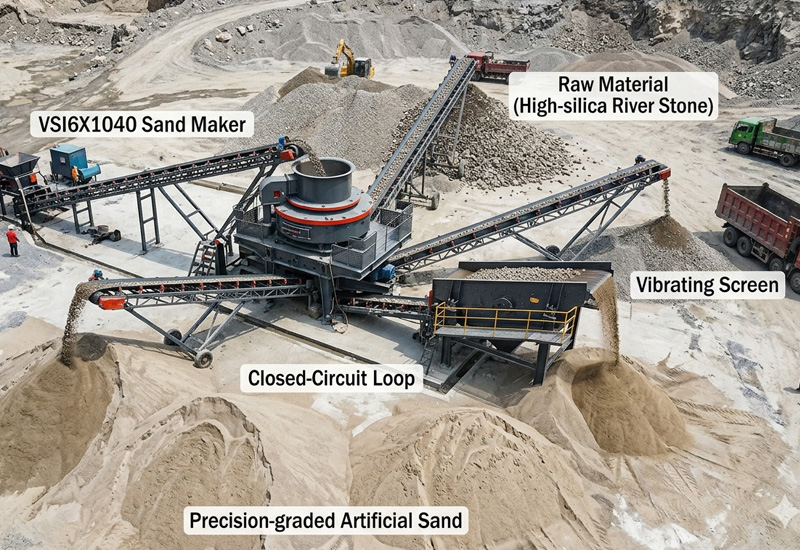
The tertiary VSI stage provides further shaping and, where required, controlled production of manufactured sand. A VSI accelerates rock particles against a rotor or crushing chamber, producing intense rock-on-rock or rock-on-anvil impact. This mechanism can improve cubicality and generate a more favorable particle geometry than compression stages alone.
Aggregate Gradation and Shape Control
Gradation control is central to high-specification aggregate production. Each crushing stage should be selected according to the feed size, target product sizes, and reduction ratio required at the next stage. Screening between stages separates correctly sized material from oversize particles, preventing unnecessary crushing and helping maintain stable crusher loading.
Closed-circuit operation is especially important for precise gradation. Material discharged from a crusher is screened, and particles larger than the specified top size are returned to the appropriate crusher for another pass. This recirculation continues until particles meet the required size range. While higher circulating loads can increase crusher utilization, excessive recirculation wastes energy and reduces effective plant capacity. The objective is therefore to maintain the lowest practical circulating load consistent with the required product specification.
Particle shape requires a similarly coordinated approach. Compression crushers can sometimes generate elongated or flaky particles, particularly when operating outside their optimal reduction range. A secondary impact crusher or tertiary VSI can counter this tendency by applying selective impact forces that improve particle cubicality. The VSI should not simply be treated as a final-size crusher; its value lies in shaping particles and producing controlled fines when the application requires manufactured sand.
Matching Equipment to Rock Hardness
Rock characteristics strongly influence equipment selection. Granite and basalt have high compressive strength and significant abrasiveness, favoring robust jaw and cone crushers equipped with wear-resistant components. Cones generally provide efficient secondary reduction in these conditions, although operating settings must be monitored as liners wear.
Limestone is typically softer and less abrasive, allowing greater flexibility. Impact crushers can deliver efficient reduction while producing favorable particle shape, potentially reducing the number of crushing stages required for some products. However, excessive impact energy can generate unwanted fines, so rotor speed, feed size, and chamber configuration must be matched to the desired gradation.
A high-performance plant should therefore avoid selecting crushers solely by nominal tonnage. Feed characteristics, required reduction ratio, moisture, abrasiveness, target gradation, shape requirements, and downstream screening capacity must all be considered.
Synchronizing the Circuit for Maximum Efficiency
Effective circuit design treats the crushers, screens, feeders, and conveyors as one production system. Feeders should provide stable loading to prevent crusher starvation or surging. Screens must have sufficient capacity to classify the crusher discharge accurately. Crusher settings should be coordinated so that each stage performs an economically appropriate amount of reduction rather than forcing one machine to compensate for another.
Automation can further stabilize production by monitoring crusher power, feed rates, product size, and circulating load. Adjusting closed-side settings, VSI rotor speed, or feeder rates in response to changing rock characteristics helps maintain product consistency throughout the operating shift.
Ultimately, high-specification aggregate production is achieved through balanced reduction rather than maximum individual crusher output. A jaw crusher establishes reliable primary reduction, a cone or impact crusher performs controlled secondary crushing, and a VSI provides final shaping and sand production. When these stages are properly matched with screening and recirculation systems, the plant can maintain tight gradation, improve particle shape, accommodate granite, basalt, and limestone, and minimize inefficient circulating loads. The result is a more stable, energy-conscious crushing operation capable of producing consistently high-quality aggregate at commercial scale.