
Economic benefits of stone crushers in quarry
In aggregate production and mining, a quarry is only as viable as its processing efficiency. At the heart of this viability lies the stone crusher. While often viewed simply as mechanical brutes designed to break rock, modern crushing assets are actually sophisticated economic engines.
Investing in high-tier, modern crushing technology triggers a profound financial transition: it shifts a quarry operation from a high-CapEx liability into a low-OpEx, high-margin powerhouse. Here is a multi-dimensional look at how these assets dictate the bottom line.
The Financial Pivot: From High CapEx to Low Per-Ton OpEx
The initial Capital Expenditure (CapEx) for premium crushing machinery—such as European-type jaw crushers, advanced cone crushers, or vertical shaft impactors (VSI)—can give operators pause. However, evaluating a crushing asset solely on purchase price is a classic financial pitfall. The true metric of quarry profitability is the Total Cost of Ownership (TCO) per ton.
High Initial CapEx ──► Advanced Automation & Metallurgy ──► Drastically Lower OpEx ──► Higher Long-Term Margins
Modern crushing assets achieve a remarkably low operational expenditure (OpEx) per ton through several vectors:
-
Energy Efficiency: Next-generation motors and optimized transmission systems drastically reduce kilowatt-hour consumption per ton of crushed material. Given that energy is one of a quarry’s highest ongoing costs, this scaling efficiency directly pads the margin.
-
Highly Durable Wear Parts: Advanced metallurgy in jaw plates, mantle liners, and blow bars extends the component lifespan. Fewer changeouts mean lower maintenance labor costs and reduced purchasing frequency.
-
Maximizing Uptime: Premium assets are engineered for rapid maintenance (e.g., hydraulic clearing and adjustment systems). Minimizing unplanned downtime ensures the plant continuously amortizes its fixed costs over a massive volume of output.
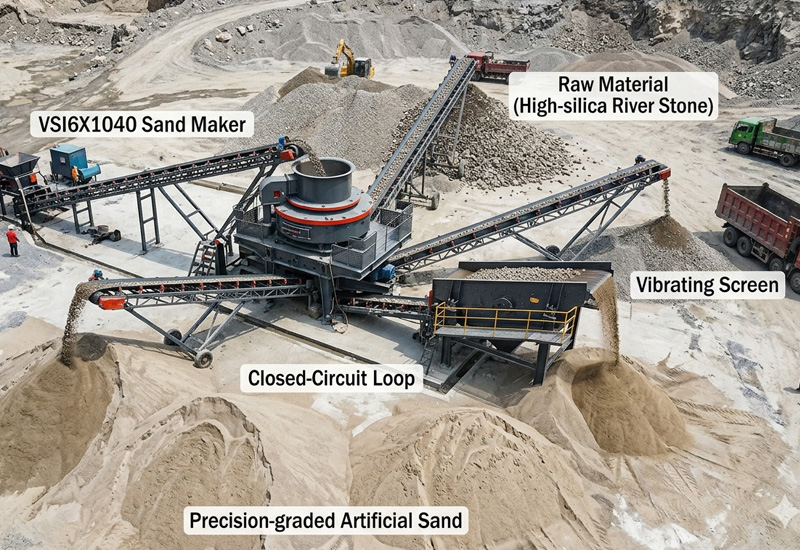
Grain Shape Optimization: Turning Geometry into Premium Revenue
The economic impact of a crusher extends far beyond throughput; it fundamentally dictates product quality and, consequently, market pricing. In modern construction, the geometry of the aggregate is paramount.
Traditional or poorly maintained crushers often produce elongated, flaky particles. These shapes create weak points in concrete and asphalt, requiring more cement paste or bitumen to bind effectively. Conversely, premium crushing assets—particularly VSI sand-making machines and specialized cone crushers—utilize high-velocity impact and inter-particle crushing to produce highly cubical, premium grain shapes.
The Pricing Premium of Cubical Aggregate
| Metric | Elongated / Flaky Aggregate | Cubical / Premium Aggregate (Modern Crushing) |
| Market Demand | Low-tier sub-base, general fill | High-strength concrete, asphalt, infrastructure |
| Value Proposition | High void age, requires more binder | Low void age, optimal interlocking, saves binder costs |
| Price Command | Standard commodity rates | Premium pricing (often 15%–30% higher margins) |
By deploying assets that strictly control grain shape, a quarry exits the low-margin commodity race and enters the premium supply chain for high-performance concrete, major highway contracts, and specialized infrastructure projects.
Multi-Dimensional Economic Ripples Across the Quarry Lifecycle
The financial benefits of optimized crushing ripple across the entire quarry ecosystem:
Downstream Savings in Screening and Washing
When a crusher delivers a highly predictable, tightly bounded particle size distribution (PSD), it reduces the recirculating load on screens. This means screening media wears out slower, and less energy is wasted re-routing oversized material back through the circuit. Furthermore, optimized crushing minimizes the production of unsellable ultra-fines (“quarry dust”), maximizing the sellable yield per blast.
Adaptability to Market Shifts
Modern crushing assets feature modular configurations and easily adjustable settings (such as variable speed drives and adjustable closed-side settings). If local demand shifts from coarse railway ballast to fine manufactured sand (M-sand), the quarry can pivot its production mix within hours rather than undergoing a costly, multi-month plant overhaul. This agility allows operators to capture high-margin market spikes in real time.
The Bottom Line
A stone crusher should not be budgeted as a mere operational cost, but rather as a strategic financial asset. While the upfront CapEx of premium crushing machinery represents a significant commitment, its ability to compress per-ton OpEx while simultaneously unlocking premium product pricing completely reshapes a quarry’s balance sheet. In the modern aggregate market, precision crushing is the ultimate separator between a struggling operation and a highly profitable enterprise.