
100-150 t/h aggregate crushing plant for sale
A 100–150 t/h aggregate crushing plant is a practical production solution for contractors, quarry operators, and aggregate producers seeking a compact system with stable output. However, achieving a reliable 100–150 t/h is not simply a matter of selecting crushers with sufficient nominal capacity. The plant must be synchronized from the feed hopper through primary crushing, secondary crushing, screening, and closed-circuit recirculation.
A well-balanced configuration can use a C6X Jaw Crusher or PE Jaw Crusher as the primary crusher, an HST/HPT Cone Crusher or CI5X Impact Crusher for secondary crushing, and an S5X Vibrating Screen for classification.
Designing the Crushing Plant Around Material Flow
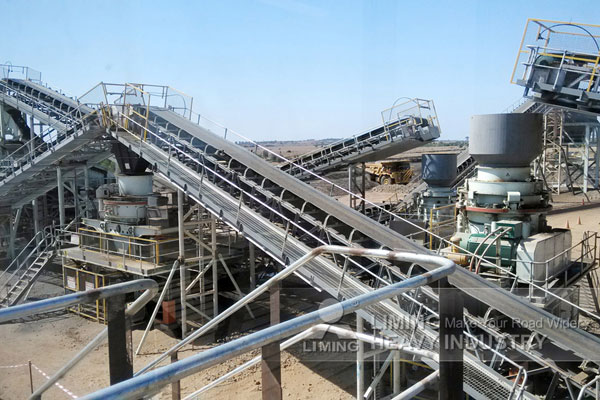
The basic process begins with raw aggregate entering the feed hopper and passing through a vibrating feeder into the primary jaw crusher. The jaw crusher reduces large rocks to a manageable size for secondary crushing. Crushed material then moves to the cone or impact crusher before reaching the S5X vibrating screen.
The screen separates the crushed material into different size fractions. Oversize material is returned to the secondary crusher through a recirculation conveyor, while correctly sized material is discharged as finished aggregate.
This closed-circuit configuration is important because it allows the plant to maintain product specifications without unnecessarily crushing material that has already reached the desired size.
For a target production of 100–150 t/h, the layout should be designed around the actual continuous production rate, rather than the maximum theoretical capacity printed in individual equipment specifications. Surge capacity should also be incorporated between stages to absorb short-term fluctuations in feed rate.
CSS Calibration: Controlling Crusher Performance
Closed-side setting (CSS) is one of the most important variables when balancing a crushing circuit. On the primary jaw crusher, CSS determines the size of material delivered to the secondary stage. If the jaw crusher is operated with an excessively tight setting, power consumption and wear can increase. If the setting is too wide, the secondary crusher and screen may receive oversized material that reduces overall efficiency.
The secondary crusher requires equally careful calibration. For an HST or HPT cone crusher, CSS influences the final product gradation and the quantity of material returned by the screen. With a CI5X impact crusher, rotor speed, feed size, and discharge setting must similarly be matched to the desired aggregate specification.
The goal is not simply to achieve the smallest possible product. Instead, CSS should be adjusted so that the secondary crusher produces enough correctly sized material to keep the screening circuit operating near its intended 100–150 t/h throughput.
Balancing the S5X Screening Decks
Screening capacity can easily become the hidden limitation in an aggregate plant. The S5X Vibrating Screen should therefore be selected and configured according to the required product sizes, feed characteristics, and circulating load.
Consider a simplified example in which the plant receives 150 t/h of feed. After primary and secondary crushing, part of the material may already meet the required specifications, while the remaining oversize must return to the crusher. If 30% of the screened material is classified as oversize, the secondary crushing circuit may experience a circulating load substantially above the fresh-feed rate.
This means conveyors, crushers, and screens must be sized for circulating material, not merely the nominal 100–150 t/h of new feed.
Screen-deck loading should also be considered. The top deck handles larger particles and normally carries the greatest impact and material burden, while lower decks perform finer separation. Correct screen aperture selection and adequate screening area help prevent blinding, buildup, and excessive recirculation.
Building a Synchronized Closed-Circuit Plant
For a 100–150 t/h plant, synchronization should be evaluated as a complete system:
Raw feed → Hopper → Vibrating Feeder → C6X/PE Jaw Crusher → HST/HPT Cone or CI5X Impact Crusher → S5X Vibrating Screen → Finished Products + Oversize Recirculation
Conveyor widths, transfer points, motor power, crusher settings, screen area, and surge capacity should all be evaluated together. The ideal layout minimizes unnecessary transfer distances and ensures that recirculated oversize returns smoothly to the secondary crusher rather than accumulating at transfer points.
Ultimately, purchasing a 100–150 t/h aggregate crushing plant for sale should involve more than comparing individual machine prices. A properly balanced C6X/PE primary crusher, HST/HPT or CI5X secondary crusher, and S5X screening system can provide dependable production when CSS, circulating load, screening capacity, and feed-hopper design are calibrated as one integrated process.