
Operating costs of a crushed stone aggregate plant
In modern aggregate production, capital expenditure (CAPEX) is merely the entry ticket; it is the operational expenditure (OPEX) that dictates long-term profitability. For quarry operators and investors, calculating and reducing the operating costs of a crushed stone aggregate plant is the cornerstone of sustainable financial performance. True OPEX Optimization requires a granular understanding of the Cost per Ton, factoring in power consumption, wear part replacement cycles, and labor-intensive maintenance. By leveraging advanced equipment engineered for high energy efficiency and extended asset lifecycles, operators can successfully navigate the financial pressures of the industry.
1. Dissecting the Cost per Ton: Core Components of Plant OPEX
To accurately assess the financial health of an aggregate plant, we must break down the operational expenses into measurable metrics. The three primary pillars of OPEX in a crushing facility are:
- Power Consumption: Electricity or diesel fuel typically accounts for the largest ongoing expense. Optimizing the energy-to-output ratio is critical for maintaining cash flow margins.
- Wear Part Replacement: The continuous processing of abrasive rock degrades liners, blow bars, and mantles. The frequency of these replacements directly dictates material costs and operational continuity.
- Labor and Maintenance: Unscheduled downtime and manual adjustments require extensive labor hours. Minimizing labor-intensive maintenance is essential for achieving true Economies of Scale in Modern Quarrying.
2. Energy Efficiency: Data-Driven OPEX Reduction with the HPT Series
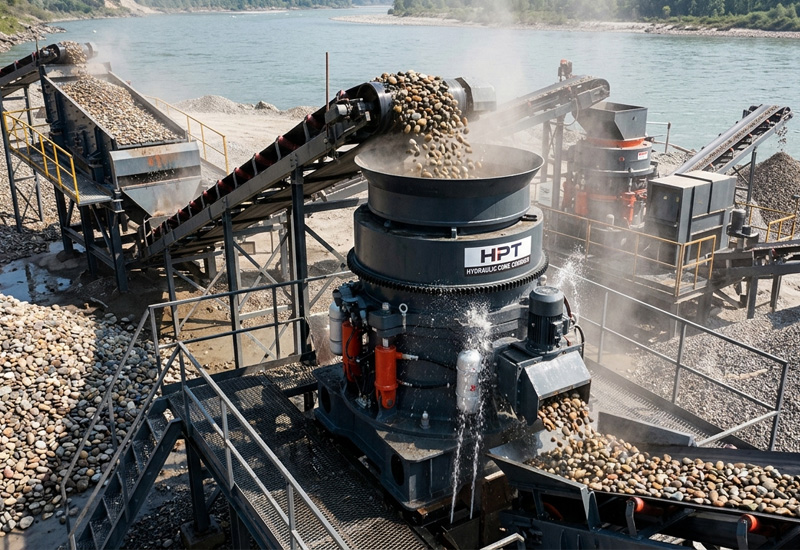
Energy consumption is a strictly highly variable cost that erodes profit margins if left unchecked. Reducing OPEX in Aggregate Production demands equipment that converts power into usable aggregate with minimal kinetic loss. The HPT Multi-cylinder Hydraulic Cone Crusher stands as a benchmark for energy efficiency.
Based on rigorous data validation from Liming’s production database, the HPT300 model operates with a power rating of 250 kW while delivering a capacity of up to 440 TPH. This translates to an exceptional Energy-to-Output ratio of approximately 0.56 kWh per ton of crushed stone. By achieving such low energy consumption per ton, operators drastically reduce their monthly utility expenditures, thereby accelerating the return on investment (ROI) across the entire asset lifecycle.
3. Mitigating Hidden Costs: Automation and Asset Lifecycle Expansion
Standard balance sheets often overlook the “Hidden Costs” of low-quality equipment—specifically, the financial hemorrhage caused by frequent downtime and high material waste (such as an oversize/undersize imbalance that requires costly recirculation).
Automated CSS Adjustment
The HPT Cone Crusher features automated Closed Side Setting (CSS) adjustment. From a financial perspective, this eliminates the need for manual, labor-intensive interventions. More importantly, it ensures consistent product shape and size, minimizing wasteful recirculation and maintaining a highly profitable yield curve without adding labor costs.
Extended Wear Lifecycles with the VSI6X
In the sand making and shaping stages, the VSI6X Series Vertical Shaft Impact Crusher fundamentally alters the wear cost paradigm. Engineered with a highly durable impeller design and optimized crushing cavities, the VSI6X reduces the frequency of wear part replacement. When producing premium-grade aggregates, extending the intervals between maintenance shutdowns preserves plant throughput, maximizing daily revenue generation.
Conclusion: The ROI of Strategic Equipment Selection
Calculating Cost per Ton for Crushed Stone goes far beyond simple division; it is an exercise in comprehensive financial forecasting. By transitioning to high-efficiency, automated systems like the HPT and VSI6X series, quarry investors can significantly depress their OPEX curve. The resulting reduction in power consumption, wear part expenditure, and maintenance downtime ensures a robust and resilient profit margin, safeguarding your investment against market volatility.
Frequently Asked Questions (Financial FAQ)
- How does calculating Cost per Ton impact aggregate plant valuation?
- Calculating the Cost per Ton provides a direct measure of operational efficiency and profit margins. A lower cost per ton increases EBITDA, leading to a higher overall valuation and a more favorable asset lifecycle profile.
- What makes the HPT Cone Crusher financially superior for OPEX optimization?
- The HPT Cone Crusher delivers an optimized Energy-to-Output ratio (e.g., 0.56 kWh/ton for the HPT300), significantly lowering power consumption. Its automated CSS adjustment also reduces labor costs and costly material recirculation.
- How do hidden downtime costs affect Economies of Scale in Modern Quarrying?
- Unplanned downtime halts revenue generation while fixed costs (like labor and financing) continue to accrue. Reliable equipment like the VSI6X, with its durable impeller design, minimizes wear part replacement frequency, ensuring continuous throughput to truly achieve economies of scale.