
Fine stone crusher for sand making plant
The growing demand for high-quality manufactured sand has increased the importance of advanced fine stone crushers in modern aggregate processing plants. As natural sand resources become increasingly limited, manufacturers must produce consistent, premium-grade concrete sand from crushed rock. Achieving this requires more than conventional crushing equipment. It demands an intelligently engineered tertiary and quaternary crushing and shaping circuit capable of controlling particle size distribution, fineness modulus (FM), and particle morphology.
A high-performance fine stone crusher for a sand making plant typically integrates VSI6X Series vertical shaft impactors, HPT Series fine hydraulic cone crushers, and S5X Series high-frequency vibrating screens. Together, these technologies provide an efficient solution for producing cubical, well-graded manufactured sand while maintaining high throughput and operational stability.
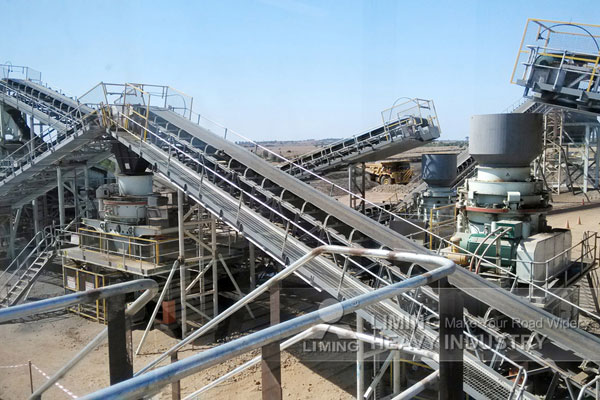
1. Advanced Tertiary Crushing with HPT Hydraulic Cone Crushers
The tertiary crushing stage plays a critical role in reducing intermediate-sized aggregates into material suitable for fine crushing and shaping. HPT Series hydraulic cone crushers offer an effective solution for this application, combining high crushing capacity, optimized chamber geometry, and hydraulic adjustment technology.
Their layered compression crushing mechanism processes material through inter-particle pressure, reducing oversized particles while maintaining consistent product quality. By selecting appropriate crushing chambers, closed-side settings, and feed gradations, operators can optimize the production of fine aggregates.
The HPT Series also supports stable operation under demanding production conditions. Its hydraulic protection and adjustment systems help manage uncrushable materials, maintain equipment performance, and reduce unnecessary downtime.
For manufactured sand applications, the HPT crusher should be configured to produce a controlled feed for the subsequent VSI shaping stage rather than attempting to generate the final sand product independently.
2. Quaternary Crushing and Shaping with VSI6X Series
The VSI6X Series vertical shaft impact crusher is a central component of advanced fine stone crushing circuits. Unlike conventional compression crushers, VSI equipment uses high-speed impact to improve particle shape and produce finer aggregate fractions.
Two important crushing configurations are available:
Rock-on-rock crushing: Material accelerates through the rotor and collides with a surrounding rock bed. This autogenous crushing mechanism promotes particle-to-particle fragmentation, improving cubical shape while reducing direct wear on metallic components.
Rock-on-anvil crushing: Material is accelerated against impact anvils or wear-resistant surfaces. This configuration provides more intensive impact energy and can be advantageous when greater reduction or shaping is required.
The VSI6X design supports flexible operating configurations to accommodate different rock types, feed sizes, and manufactured sand specifications.
By optimizing rotor speed, feed rate, material distribution, and crushing chamber configuration, operators can minimize flaky and elongated particles while improving surface texture and particle geometry. These characteristics are particularly important for concrete sand, where particle shape influences workability, packing density, and cement demand.
3. High-Frequency Screening and Precise FM Control
Crushing performance alone cannot guarantee premium manufactured sand. Accurate classification is equally important.
S5X Series vibrating screens provide efficient multi-deck screening for separating fine aggregates into controlled size fractions. Their high screening efficiency supports accurate removal of oversized particles and effective management of fine material.
The screening system should be designed around the required fineness modulus and target grading envelope. FM represents an aggregate’s overall coarseness and is calculated from cumulative percentages retained on a defined series of standard sieves.
Instead of relying on a single crusher setting, operators should adjust the proportions of different screened fractions to achieve the desired FM. This provides greater flexibility when raw material characteristics or customer specifications change.
A well-designed screening circuit also prevents excessive fines from accumulating in the final product, helping maintain consistent sand quality.
4. Dynamic Material Recirculation and Circuit Balancing
Advanced sand-making plants benefit significantly from closed-circuit operation.
Oversized particles discharged from the S5X screening system can be redirected to the VSI6X crusher for additional shaping and size reduction. Intermediate fractions may return to the HPT cone crusher, depending on their particle size and the required reduction ratio.
This dynamic recirculation loop improves resource utilization and maintains tighter control over the finished product.
However, excessive circulating loads can reduce overall plant efficiency. Engineers should balance crusher capacity, screen throughput, conveyor dimensions, and surge-bin storage to prevent material bottlenecks.
Variable-frequency drives, automated feed regulation, and real-time monitoring can further stabilize material flow and optimize equipment utilization.
5. Producing Premium-Grade Concrete Sand
The ultimate objective of an advanced fine stone crusher plant is to deliver manufactured sand with predictable grading, favorable particle shape, and reliable performance in concrete applications.
A practical configuration combines HPT tertiary crushing, VSI6X quaternary crushing and shaping, and S5X multi-deck screening within a coordinated closed-loop system.
Performance optimization should focus on several parameters:
- Consistent fineness modulus and particle size distribution.
- High proportions of cubical particles.
- Reduced flakiness and elongation.
- Controlled ultrafine and microfine content.
- Stable production capacity and circulating load.
- Efficient energy consumption and wear-part utilization.
Regular laboratory testing, sieve analysis, particle-shape assessment, and concrete performance trials should guide operational adjustments.