
Aluminum ore crushing and processing equipment
Efficient aluminum ore processing begins with understanding that bauxite is not simply a hard rock that can be reduced by applying greater crushing force. Its mineralogy, moisture content, clay fraction, and rheological behavior strongly influence fracture mechanics and equipment performance. Bauxite commonly contains gibbsite, boehmite, or diaspore, together with varying proportions of iron oxides, silica minerals, and clay minerals. These constituents can produce substantial differences in abrasiveness, compressive strength, and stickiness, making crusher selection and chamber design critical to stable operation.
Crushing Physics and Bauxite Mineralogy
Primary crushing normally relies on a jaw crusher to apply compressive and tensile stresses between a fixed and moving jaw. Fracture begins when applied stress exceeds the rock’s strength, producing cracks that propagate through mineral boundaries and internal defects. The objective is not merely maximum force but controlled energy application that generates the required reduction while limiting excessive fines and equipment wear.
Bauxite hardness can vary considerably with mineral composition. Softer, gibbsite-rich material may fracture relatively readily, whereas harder boehmitic or diasporic zones can impose greater mechanical loads. Although Mohs hardness alone does not define crusher performance, increasing hardness generally raises abrasive interaction between the feed and wear surfaces. Siliceous and iron-rich gangue can further intensify abrasion.
This variation affects jaw-chamber geometry. A chamber with an appropriate nip angle must maintain positive gripping of the largest particles without allowing them to slip upward. Excessive compression can increase power consumption and generate unnecessary fines, while insufficient compression produces poor reduction and recirculating oversize. Jaw profile and tooth geometry should therefore accommodate the expected range of bauxite competency rather than a single laboratory hardness value.
Moisture, Clay, and Sticky-Ore Behavior
The more difficult problem in many bauxite circuits is not hardness but moisture-driven adhesion. High clay content combined with elevated moisture can transform crushed ore into a cohesive, plastic mass. Instead of behaving as discrete particles, the feed can smear against liners, bridge across hopper openings, and form compacted layers in crusher discharge zones.
This behavior changes the effective mechanics of crushing. In a jaw crusher, sticky fines can fill the voids between larger particles and reduce the chamber’s ability to discharge material during the opening portion of the crushing cycle. The result can be packing, increased pressure, reduced throughput, and irregular product sizing. The toggle plate and associated linkage are then exposed to more sustained loading rather than the intended intermittent crushing forces.
Chamber geometry should consequently provide sufficient open volume and unobstructed discharge paths. Jaw profiles that promote material release are particularly valuable for wet, clay-rich feeds. Feed-hopper angles must also exceed the material’s effective angle of repose under wet conditions, while smooth or appropriately lined surfaces can reduce adhesion. Where practical, controlled feed sizing and moisture management upstream of the crusher can be more effective than attempting to overcome severe bridging through increased crusher power.
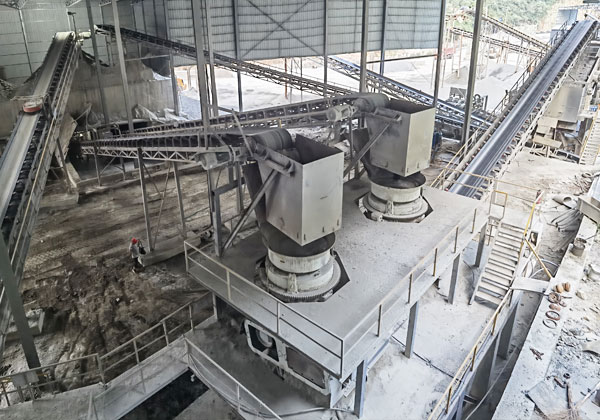
Secondary Hydraulic Cone Crushing
After primary reduction, hydraulic cone crushers provide controlled secondary crushing through compression between the mantle and concave. Fracture occurs as particles are compressed repeatedly within the crushing chamber, with interparticle breakage contributing to efficient size reduction.
Harder bauxite and abrasive gangue tend to create concentrated wear zones on the mantle and concave. Wear patterns are influenced by feed size distribution, eccentric motion, crushing pressure, and the location at which particles enter the chamber. Uneven feed can produce localized mantle wear, changing the chamber profile and consequently altering the crushing force distribution.
For sticky bauxite, however, the principal concern can become packing rather than abrasion. Wet clay can coat the mantle and concave, reducing effective crushing volume and restricting discharge. Hydraulic adjustment and tramp-release systems can help protect the crusher from overload, but they cannot compensate indefinitely for a poorly flowing feed. Correct closed-side setting, adequate chamber volume, and controlled feed presentation are essential to maintaining stable crushing action.
Designing for Wear and Flow Stability
Optimal aluminum ore crushing requires balancing fracture efficiency against material handling behavior. Harder feed favors robust wear materials and chamber profiles capable of sustaining high compressive loads. Softer but highly plastic ore requires greater attention to discharge geometry, anti-bridging measures, and moisture control.
Mantle wear should be monitored for changes in the crushing profile rather than judged solely by remaining liner thickness. Similarly, jaw-plate wear should be evaluated for changes in tooth or corrugation geometry that affect particle grip and discharge. Excessive localized wear can alter the nip angle and reduce effective fracture energy.
Ultimately, successful bauxite crushing circuits integrate mineralogical variability with mechanical design. Jaw crushers must maintain reliable gripping and toggle dynamics across changing hardness, while hydraulic cone crushers must preserve controlled compression without allowing clay-rich, wet material to pack the chamber. Proper hopper geometry, feed regulation, moisture management, and systematic liner monitoring together prevent bridging and discharge clogging while maintaining efficient fracture mechanics. The result is a more stable circuit, predictable product sizing, lower unplanned downtime, and improved utilization of downstream aluminum-processing equipment.