
Cost per cubic meter of crushed stone aggregate
In high-output aggregate production, long-term commercial survival depends on a single metric: the cost per cubic meter of crushed stone aggregate. Operational Expenditure (OPEX) is often inflated by inefficient equipment configurations, mismatched capacities, and premature wear cycles. For quarry owners and investment strategists, minimizing this unit cost requires transitioning from raw Capital Expenditure (CAPEX) assessment to strict Total Cost of Ownership (TCO) optimization.
By dissecting the core financial variables—electricity consumption, wear-part replacement cycles, maintenance labor, and raw material utilization—this analysis demonstrates how a synchronized multi-stage crushing circuit lowers unit production costs compared to legacy systems in hard rock processing.
The Anatomy of Aggregate OPEX: Financial Variables
Calculating the true cost per cubic meter of crushed stone aggregate requires breaking down daily operational variables into predictable, measurable units. The standard density conversion factor for crushed stone is approximately 1.6 tons per cubic meter, meaning any efficiency gains at the tonnage level directly compound your volumetric margins.
| OPEX Cost Component | Primary Financial Driver | Target Benchmark (Per Ton) | Impact on Cost per Cubic Meter |
|---|---|---|---|
| Power Consumption | Electricity usage per ton (kWh/t) matched to motor efficiency. | 0.8 – 1.2 kWh/t | Directly scalable; minimized by eliminating idle equipment run-time. |
| Wear Components | Replacement cycles of manganese liners, jaw plates, and mantles. | Hard Rock: 150–200 Hours (Impact) vs. 800+ Hours (Cone) | Main cause of unexpected maintenance spikes and unit cost inflation. |
| Maintenance Labor | Scheduled servicing, lubrication, and unplanned downtime losses. | < 5% of total hourly operating cost | Drives down fixed asset utilization rates when maintenance is high. |
| Material Utilization | Raw feed conversion efficiency vs. unsellable waste fines generated. | > 85% usable aggregate yield | Lower generation of low-value fines increases net margin per m³. |
1. Electricity Consumption Metrics
Power delivery systems represent a major recurring expense in aggregate plants. When crushers operate below their rated capacities, the system experiences severe idle power losses, driving up the net kilowatt-hours consumed per ton. Amperage draws must remain closely tied to continuous material flow to maintain an optimal energy-to-yield ratio.
2. Wear-Part Lifecycle Volatility
Processing abrasive materials like granite, basalt, or quartzite accelerates wear on contact parts. In an unoptimized system, the cost of jaw plates, mantles, and liners increases because of frictional shearing forces rather than compressive crushing. This shortens component lifecycles and requires frequent shutdowns for replacement.
3. Maintenance Labor and Asset Downtime
Every hour spent on maintenance carries a double financial penalty: the direct cost of specialized technical labor and the opportunity cost of lost aggregate production. Legacy machinery without automated monitoring systems often requires extended maintenance teardowns, driving up overall production costs.
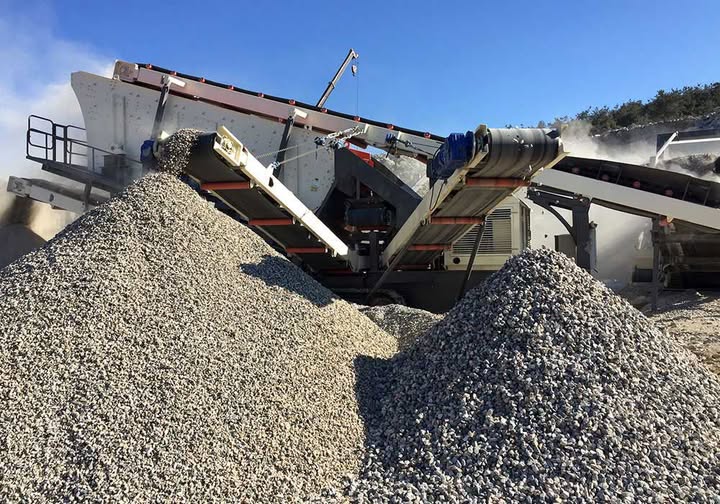
Circuit Architecture: Jaw + Hydraulic Cone vs. Legacy Impact Systems
Achieving a low cost per cubic meter of crushed stone aggregate requires matching your machinery configurations to the abrasiveness of the rock. Selecting the wrong equipment for secondary and tertiary reduction can quickly erode profit margins.
Financial Reality Check: Deploying impact crushers in high-silica, hard rock environments causes rapid blow-bar wear and excessive fines generation. For materials with a Mohs hardness greater than 6, a multi-stage compressive crushing strategy is essential for protecting your bottom line.
The High-Wear Impact Fallacy
Impact crushers rely on high-velocity impact forces to fracture stone. While effective for soft, non-abrasive limestone, passing hard rock through an impactor causes rapid wear on blow-bars and apron liners. This configuration results in short wear cycles (often requiring replacement every few hundred hours), high utility costs, and a high volume of unsellable crusher dust under 2mm. This waste reduces the yield of profitable aggregate sizes, inflating the net production cost for every usable cubic meter produced.
The Compressive Advantage: Multi-Stage Synchronization
A modernized, multi-stage compressive circuit utilizes high-capacity jaw crushing for primary reduction, followed by automated hydraulic cone crushing for secondary and tertiary sizing. This design replaces high-velocity impacts with inter-particle compression. This shift limits wear to predictable, uniform manganese erosion, lowers power consumption per ton, and produces an optimized particle size distribution with high cubical consistency and minimal waste fines.
Engineered Plant Efficiency: PEW Jaw and HPT Cone Synchronicity
To ground these financial principles in operational reality, we analyze a high-efficiency crushing circuit using specific machinery from the Liming product line: the PEW860 Primary Jaw Crusher matched with the HPT300 Hydraulic Cone Crusher. This combination demonstrates how aligning power-to-capacity metrics minimizes energy waste and optimizes unit production costs.
| Crushing Equipment Model | Operational Role | Real-World Capacity (t/h) | Rated Power (kW) | OPEX Stabilization Advantage |
|---|---|---|---|---|
| PEW860 | Primary Reduction | 150 – 410 t/h | 110 kW | High-inertia flywheel reduces peak motor strain; V-shaped crushing chamber prevents bridging. |
| HPT300 | Secondary/Tertiary Sizing | 110 – 440 t/h | 220 kW | Laminated crushing action optimizes particle shape; hydraulic CSS adjustments eliminate manual downtime. |
Eliminating Capacity Bottlenecks and Idle Power Waste
A frequent cause of high aggregate production costs is a capacity mismatch between the primary and secondary crushing stages. If the primary crusher cannot consistently feed the secondary stage, the secondary crusher runs empty or under-loaded. This leads to idle energy consumption, poor inter-particle crushing, and accelerated localized liner wear.
The PEW860 and HPT300 are engineered to operate in tandem:
- Synchronized Throughput: The PEW860 delivers an intermediate product feed within the 150–410 t/h range, matching the HPT300’s optimal operational sweet spot of 110–440 t/h. This maintains a choked cavity condition in the cone crusher.
- Choked Cavity Efficiency: Operating under a choked feed allows the HPT300 to utilize inter-particle crushing dynamics. This process uses stone-on-stone compression rather than stone-on-manganese impact, improving the cubical shape of the aggregate while protecting the liner surfaces.
- Optimized Power-to-Capacity Ratio: Delivering a combined 330 kW of crushing force without excess power consumption, this configuration ensures the motor load matches the material volume. This reduces electricity costs per ton and lowers the total cost per cubic meter of the finished aggregate.
Long-Term Cost Analysis: Amortization and Strategic Value
Transitioning from a legacy, high-wear system to an automated PEW + HPT compressive circuit involves capital investment, but the return on investment comes from regular operational savings. Lower power bills, fewer wear-part purchases, and reduced maintenance labor directly lower production costs, improving net margins for every cubic meter sold.
For investment strategists, managing the cost per cubic meter of crushed stone aggregate is a long-term strategy. By choosing high-efficiency, matched machinery configurations, operators can stabilize their operating expenses, maximize material yields, and secure a predictable cost per cubic meter over the life of the quarry asset.
Frequently Asked Questions Regarding Aggregate Production Costs
- How does material density affect the cost per cubic meter of crushed stone aggregate?
- Crushers process materials by weight (tons), but aggregate is often sold or calculated by volume (cubic meters). A denser rock like basalt (~1.65 t/m³) requires more energy and causes more wear per cubic meter processed than a lighter rock like soft limestone (~1.4 t/m³). Converting your target plant capacities accurately from tons to cubic meters is essential for precise financial forecasting.
- Why is a choked cavity condition important for lowering cone crusher OPEX?
- A choked cavity means the crushing chamber is completely filled with material. This design forces rock-on-rock compression (inter-particle crushing) rather than rock-on-steel impact. This approach improves the cubical shape of the aggregate and reduces wear on the mantle and bowl liners, extending part life and lowering replacement costs.
- What is the financial impact of generating excess fines below 2mm?
- Excess fines represent quarried, hauled, and crushed material that often sells at a low price or is discarded as waste. High-wear impact configurations can generate 20–25% fines in hard rock, whereas a synchronized Jaw + Hydraulic Cone circuit keeps fines generation closer to 10–12%. Minimizing waste fines increases your yield of high-value aggregate sizes, lowering your net cost per cubic meter.
- How do automated hydraulic adjustments on the HPT300 lower labor expenses?
- Traditional mechanical crushers require manual adjustments to change the Closed Side Setting (CSS) or clear blockages, leading to plant downtime and higher labor costs. The HPT300 utilizes a hydraulic system that allows operators to adjust settings remotely and automatically clear the chamber after a power interruption, reducing maintenance labor and maximizing production uptime.