
Crushing ratio requirements for limestone material
Achieving the optimal reduction ratio for limestone material requires a precise balance between primary jaw crushing for initial volume reduction and high-performance secondary impact crushing to ensure grain shape quality. For medium-hardness limestone, utilizing a CI5X series impact crusher in a closed-circuit configuration allows for a higher reduction ratio in a single pass, effectively decreasing the total number of stages and lowering the initial investment for the entire production line.
Reduction Ratio Logic: Balancing Feed Size and Fineness Modulus
In limestone processing, the reduction ratio is defined as the ratio of the feed size to the product size. Since limestone typically exhibits medium hardness, the system design must prioritize “crushing by impact” over “crushing by pressure” to avoid high internal stress in the aggregate. To maintain a consistent Fineness Modulus, the primary stage must reduce raw material (often up to 800mm or 1000mm) to a manageable size for the secondary stage. A typical reduction ratio for a primary jaw crusher ranges from 3:1 to 5:1, while a secondary CI5X impact crusher can achieve ratios as high as 10:1 to 15:1 depending on the cavity configuration and rotor speed.
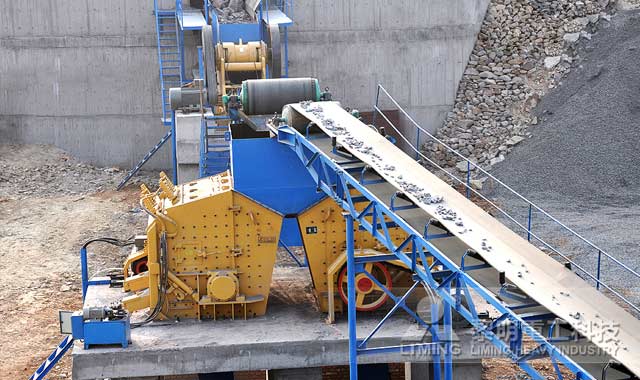
Primary Stage: Jaw Crusher Feed and Discharge Parameters
The primary stage is responsible for the heaviest volume reduction. For large-scale limestone quarries, machines like the C6X series or PE series provide the structural integrity needed to handle the maximum feed size. For instance, the PE900X1200 jaw crusher handles a Max_Feed of 750mm. The goal here is not final gradation but preparing a uniform feed for the secondary impactor. Setting the Closed Side Setting (CSS) too tight in the primary stage increases wear on the jaw plates; therefore, we maintain a moderate reduction ratio to protect the machine and optimize the fuel and power expenses of the primary circuit.
Secondary Stage: Maximizing Ratio with CI5X Series Impact Crusher
The secondary stage is where the final product quality is determined. The CI5X1520 impact crusher is specifically engineered for limestone, offering a heavy rotor and high-inertia design that maximizes the reduction ratio. By using a CI5X1520, which can handle a Max_Feed of up to 700mm in specific configurations, operators can sometimes bypass a tertiary stage. This consolidation significantly reduces the upfront equipment price and simplifies the material flow across the site.
| Machine Model | Category | Max Feed (mm) | Power (kW) | Capacity (tph) |
|---|---|---|---|---|
| PE900X1200 | Primary Jaw | 750 | 132 | 150-320 |
| CI5X1520 | Secondary Impact | 700 | 400-500 | 350-550 |
| PF1315 | Secondary Impact | 350 | 200-250 | 120-250 |
Gradation Control: Closed-circuit vs. Open-circuit Dynamics
To meet strict requirements for the Fineness Modulus and needle-like particle content, a closed-circuit system is mandatory for limestone. In an open-circuit, the reduction ratio is limited by a single pass. However, by incorporating a vibrating screen (such as the S5X series) and a return belt, oversized material is sent back to the CI5X crusher. This ensures that 100% of the material meets the target size, effectively increasing the “functional reduction ratio” of the plant and ensuring the profitability timeline is met through higher-quality aggregate sales.
Expert Verdict: The Solution Architect’s Perspective
Are you seeing a high percentage of “flaky” material in your 10-20mm aggregate? This is usually a symptom of an insufficient reduction ratio in your secondary stage or an improperly set rotor speed on your impactor. By upgrading to the CI5X series and optimizing your circuit synchronization, you can achieve a cubical product that meets the highest concrete standards. Send us your raw material sieve analysis and target capacity, and we will perform a quality balance analysis to eliminate your current production bottlenecks.