
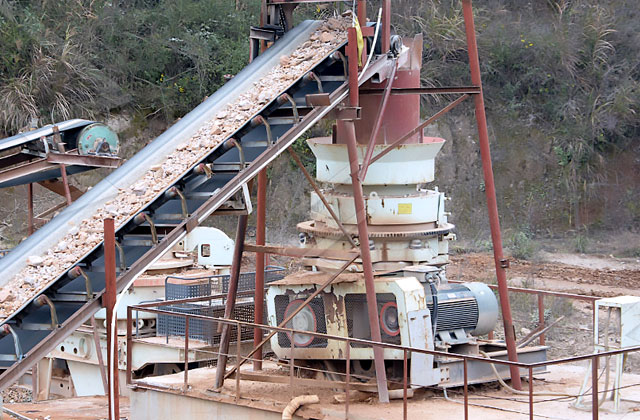
Cone crusher used in granite production line
As global infrastructure projects demand increasingly higher grades of aggregate, the granite production industry has reached a technological inflection point. For processing granite—a rock notorious for its high quartz content and extreme abrasiveness—the cone crusher has emerged not merely as a choice, but as a theoretical and practical necessity for modern production lines.
The Theoretical Foundation: Compressive vs. Impact Crushing
In the physics of comminution, granite presents a unique challenge. With a Mohs hardness typically ranging from 6 to 7, it destroys standard impact crushers (which rely on high-speed kinetic energy) through rapid wear of blow bars and liners.
The cone crusher utilizes the principle of laminated crushing (or inter-particle comminution). Instead of a single high-impact strike, the material is compressed between a moving mantle and a stationary bowl liner.
Scientific Edge: This process ensures that rocks are crushed against other rocks, rather than just the steel surface. This not only protects the machine’s components but significantly improves the cubical shape of the final aggregate—a critical requirement for high-strength concrete and asphalt.
Argument: Efficiency Through Multi-Stage Precision
A standard granite production line is a vertical hierarchy of reduction ratios. Theoretical models suggest that attempting to reach a final product size in too few steps leads to “over-crushing” and excessive fines (waste).
| Stage | Equipment | Feed Size (mm) | Output Size (mm) | Role |
| Primary | Jaw Crusher | 500–1200 | 100–300 | Volume reduction |
| Secondary | Cone Crusher | 100–300 | 40–100 | Shape & size refinement |
| Tertiary | Cone Crusher | 40–100 | 0–20 | Precision grading |
Economic Argument: Why the Investment Pays Off
While the initial capital expenditure for a cone crusher is higher than that of an impactor or a jaw crusher, the Total Cost of Ownership (TCO) favors the cone in any granite-centric operation.
| Feature | Impact Crusher (Soft Rock) | Cone Crusher (Hard Rock/Granite) |
| Abrasive Resistance | Low (High wear costs) | High (Optimized for silica) |
| Product Shape | Excellent | Excellent (via lamination) |
| Maintenance Frequency | High | Low |
| Operating Cost/Ton | Higher for hard rock | Lower (up to 70% reduction) |
By reducing the circulation load in a closed-circuit system, the cone crusher lowers energy consumption per ton of finished product. It effectively handles the “secondary” and “tertiary” stages, taking coarse output from a primary jaw crusher and refining it into precise, marketable sizes (typically D80 < 12mm).
The Future of Granite Processing
As the infrastructure landscape evolves, the cone crusher remains the “intelligent heart” of the granite production line. By balancing the theoretical efficiency of interparticle comminution with the practical benefits of hydraulic automation, it provides the only sustainable path for operators looking to maximize ROI in 2026. For any quarry targeting the high-end aggregate market, the shift from “traditional” crushing to high-efficiency cone processing is no longer an option—it is a competitive necessity.