
Investment cost of limestone crushing plant
For any serious investor in the aggregate sector, calculating the investment cost of a limestone crushing plant extends far beyond the initial price tag of the machinery. From a financial perspective, the goal is not merely to “buy a crusher” but to engineer a high-yield asset that minimizes Unit Production Cost while maximizing the Internal Rate of Return (IRR). Limestone, characterized by its relatively low Mohs hardness but high demand for cubical shape, offers a unique opportunity for CAPEX optimization if the right technology is deployed from day one.
1. The Anatomy of Limestone Plant Investment
A strategic investment breakdown typically divides capital expenditure (CAPEX) into three primary buckets. Understanding this ratio is critical for maintaining capital liquidity during the startup phase:
- Core Processing Equipment (50-60%): Includes primary jaw crushers, secondary impactors, and vibrating screens. This is the heart of your revenue generation.
- Infrastructure & Auxiliary Systems (20-30%): Steel structures, conveyors, electrical automation, and foundations.
- Initial Working Capital & Compliance (10-20%): Land permits, environmental impact assessments (EIA), and spare parts inventory.
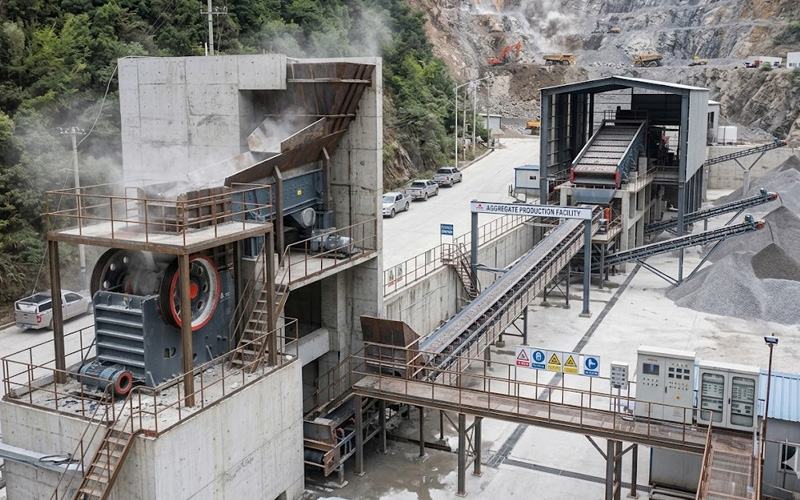
2. Cost-Efficiency: Why CI5X Impact Crushers Redefine CAPEX
In traditional limestone setups, investors often used a three-stage crushing process (Jaw-Cone-VSI). However, modern financial modeling favors the CI5X Series Impact Crusher. Due to its superior crushing ratio, the CI5X can often handle larger feed sizes and produce high-quality finished aggregates in a single pass, potentially eliminating the need for a tertiary stage.
By integrating the PEW Series Jaw Crusher for primary reduction and a CI5X Impact Crusher for secondary shaping, investors achieve:
- Reduced Energy Consumption: Lower total installed kW per ton of output compared to multi-stage cone configurations.
- Lower Wear-Part Costs: Limestones low abrasiveness makes impact crushing the most cost-effective method for achieving premium grain shape without the high maintenance costs associated with hard-rock applications.
3. Scalability and Capital Liquidity
A common pitfall is over-investing in maximum capacity before the market is fully developed. Liming’s modular design philosophy allows for incremental scalability. Investors can start with a medium-capacity line (e.g., 200-300 TPH) and add parallel modules or upgraded screens as demand increases. This “Pay-as-you-grow” model preserves cash flow and reduces the debt-service burden in the first 24 months of operation.
4. Technical Specifications for Financial Benchmarking
The following table illustrates the high-yield/low-energy ratio of Liming’s flagship limestone units, a key metric for calculating your 5-year ROI.
| Series | Model | Capacity (t/h) | Power (kW) | Max Feed (mm) | Strategic Advantage |
|---|---|---|---|---|---|
| PEW Jaw Crusher | PEW760 | 150-350 | 110 | 620 | Low OPEX primary reduction |
| CI5X Impact Crusher | CI5X1213 | 200-300 | 200-250 | 550 | High crushing ratio; eliminates tertiary stages |
| CI5X Impact Crusher | CI5X1524 | 500-700 | 560-630 | 400 | Industrial scale-up; maximum ROI at volume |
5. Financial Feasibility: The “Unit Cost” Perspective
To evaluate the true cost-effective aggregate production line, you must calculate the total cost per ton (TCPT). This includes power consumption, wear-part replacement, and labor. By utilizing the Low Energy/High Yield configuration of the PEW and CI5X series, operators can typically see a 15-20% reduction in electricity costs per ton compared to legacy models, directly boosting the bottom line.
Frequently Asked Questions: Investment Strategy
- What is the typical payback period for a 200 TPH limestone plant?
- Depending on local aggregate prices and operational efficiency, a well-configured Liming plant using CI5X technology typically achieves full CAPEX recovery within 12 to 18 months.
- How does an impact crusher lower my initial investment?
- The high crushing ratio of the CI5X Series allows it to perform the work of two machines, reducing the number of conveyors, screens, and foundations required, thus lowering initial infrastructure costs.
- Is modular design more expensive than a fixed plant?
- While the initial cost of modular components can be slightly higher, the savings in installation time (30-50% faster) and the ability to scale capital investment according to revenue make it more financially sound.